Solar YYC

How Solar Protects You from Alberta’s Rising Energy Costs

Key Takeaway: Alberta’s wholesale electricity rates are projected to increase by over 124% between 2026 and 2030 due to surging energy demand from data centers and AI infrastructure. Therefore, installing rooftop solar with Solar YYC allows homeowners to lock in predictable energy costs and avoid rising power prices and delivery fees. [1] Why are Alberta Electricity Rates Projected to Increase? Alberta’s electricity market faces upward price pressures driven by expanding artificial intelligence facilities and data centers. Demand from large-scale developments—such as Meta’s Alberta project—is expected to begin before dedicated power generation plants (like the Greenlight natural gas facility) come online, creating a supply-demand gap from 2028 to 2030. [2] According to Pembina Institute analysis, this supply gap and increased grid competition could add approximately $460 annually to a typical Alberta household’s electricity bill. [4] What Is the Alberta Wholesale Electricity Price Forecast (2026–2030)? Data from the Alberta Market Surveillance Administrator (MSA) Q2 2026 report forecasts significant growth in forward market contract prices: [1] Year Wholesale electricity price 2026 3.7¢/kWh 2027 4.7¢/kWh 2028 6.3¢/kWh 2029 7.5¢/kWh 2030 8.3¢/kWh How Does Rooftop Solar Protect Homeowners Against Rising Power Rates? Rooftop solar panel systems generate clean electricity directly at your home, offsetting two distinct utility bill charges: Alberta’s Premier has highlighted price certainty.  At an August 2026 town hall, Premier Danielle Smith said consumers who “want certainty on your bills can lock in at a price” through their electricity provider, according to The Energy Mix. [5, 6] While a fixed-rate electricity contract can provide certainty during its term, solar offers another form of protection: generating electricity at your own home, year after year. [7,8] Turn your roof into a source of long-term value With Solar YYC, part of your energy spending becomes an investment in a system you own. Every kilowatt-hour your panels produce and your home uses directly is electricity you do not need to purchase from your retailer. If your purchasing rate rises, the value of avoiding that purchase rises too. The higher electricity rates go, the more savings you will see from a Solar investment. When you produce electricity and use it directly in your home, not only do you avoid paying to buy that power, you also can avoid the usage-based delivery charges to bring it to you. For example, ENMAX Power’s published 2026 residential tariff includes approximately 5.45¢/kWh in combined variable transmission and distribution charges, before riders and other adjustments. Annual Home Savings Breakdown (8,000 kWh Direct Consumption)[3] Electricity purchase rate Energy charges avoided Delivery charges avoided Combined annual savings 8¢/kWh $640 $400 $1,040 12¢/kWh $960 $400 $1,360 16¢/kWh $1,280 $400 $1,680 At a 12¢ electricity rate, that means each kilowatt-hour used directly from your roof could avoid approximately 17¢ in energy and delivery costs. It should be noted that the above example is based on Enmax delivery charges, where a homeowner being in jurisdictions operated by wire owners such as FortisAlberta and ATCO Electric can have much higher variable costs of delivery. That is what makes solar a valuable part of planning for your home’s future. Your system can deliver savings at today’s rates while reducing your exposure if electricity becomes more expensive. Why Choose Solar YYC for Solar Panel Installation in Alberta? Your Solar YYC proposal brings the decision back to what matters: your roof, your electricity use, your investment and your expected production. Those numbers provide the foundation for understanding your potential savings. The changing electricity market adds another reason to consider the long-term value of producing your own power. If you’d like to see how Solar would provide a benefit to your own specific home, we offer complimentary quotes that tailor the system and costs, as well as savings and payback, around your individual needs and home potential. Contact Solar YYC today to request a free custom solar quote and lock in your energy savings. Information reviewed October 2026. Prices, policies and project schedules may change. Forecasts and illustrations are not guarantees of future rates or solar savings. Sources
Do Solar Panels Eliminate Your Electricity Bill in Alberta?

The short answer is: not necessarily. Solar can significantly reduce how much electricity you need to purchase from the grid. Additionally, credits from excess solar production can offset other costs throughout the year. But installing solar does not automatically mean your electricity bill disappears completely. That’s because your electricity bill is made up of more than just the electricity you use. Your savings depend on when you use electricity, how much your solar system produces, your electricity rate, and how excess solar production is credited. Your Electricity Bill Is More Than Just Electricity An Alberta electricity bill generally contains two major categories of costs: the electricity you consume and the cost of delivering that electricity to your property. Your energy charge is based on the number of kilowatt-hours (kWh) you purchase from the grid. Your bill can also contain distribution, transmission, local access, administration and other charges. The Alberta Utilities Consumer Advocate explains that energy charges are based on consumption, while the cost of delivering electricity is largely fixed. Even customers with micro-generation can continue to see distribution charges, transmission charges, local access fees and other applicable costs on their bills.[1][2]  That distinction is important because solar primarily changes how much electricity you need to buy from the grid. It does not necessarily eliminate every cost associated with remaining connected to it. So, when someone says that solar will give you a “$0 electricity bill,” there is more to the story. What Happens to the Electricity Your Solar Panels Produce? During the day, your solar system generates electricity that can be used to power your home. When your system produces more electricity than you are using, that excess electricity can be exported to the grid. Under Alberta’s micro-generation framework, small micro-generators receive credits for excess electricity supplied to the grid. Your electricity retailer is responsible for administering those credits on your bill.[3] When your panels aren’t producing enough electricity to meet your needs, you still purchase electricity from the grid. The simplest example is nighttime. Solar panels aren’t generating electricity when the sun is down, so unless you have energy stored in a battery, your home will rely on grid electricity for that portion of your consumption. This is why when you use electricity can matter almost as much as how much electricity you use. Research published in Energy Policy examined residential solar adopters and found that household characteristics and electricity-use patterns can influence the bill savings homeowners experience. The researchers specifically identified the timing and pattern of electricity use as relevant factors. A household that uses less electricity during peak daytime solar production and more during the evening can have a greater mismatch between when electricity is generated and when it is needed.[4]     In other words, two homes with similar solar systems could still see different results on their electricity bills. Summer and Winter Can Look Very Different Solar production also changes throughout the year. In Alberta, our long summer days provide considerably more opportunity for solar production than our shorter winter days. But your household’s electricity consumption may change throughout the year too. For example, one household may use considerably more electricity in the summer because it runs air conditioning. Another may use less electricity because the family is traveling more, spending more time outdoors or simply using less lighting during longer daylight hours. The Energy Policy study also found that the factors affecting solar bill savings differed between summer and winter. In other words, something associated with greater savings during the summer was not necessarily associated with the same result during the winter.[4]    Although that research studied households in four U.S. states rather than Alberta, the finding helps illustrate an important point: solar savings should be considered over a longer period rather than judged by a single month’s electricity bill. The study itself analyzed 1,577 residential solar adopters across more than 570 ZIP codes, highlighting how much individual and regional circumstances can influence results.      What About Solar Club? Your electricity plan can also make a difference. Eligible Alberta micro-generators can choose electricity plans designed specifically for homes with solar, including programs such as Solar Club. Solar Club offers a HI Rate designed for periods when a household is producing more electricity than it consumes. And LO Rate for periods when it is importing more electricity than it produces. Solar Club notes that members commonly use the HI Rate during higher-production months and move to the LO or variable rate during lower-production periods. Its optional RateSwitch program can also switch between the HI and LO rates automatically based on whether the household is a net importer or exporter. [5]  Therefore the value of your solar system isn’t determined only by how many kilowatt-hours your panels produce. The rate you receive for electricity exported to the grid also matters. Research has similarly found that electricity prices, rate structures and the way exported solar electricity is compensated can have a meaningful effect on residential solar bill savings.[4]      Can Battery Storage Help? Adding battery storage changes the equation again. Instead of exporting all of your excess daytime solar production, a battery can store some of that electricity for later use. That can allow your household to use solar-generated electricity after the sun goes down rather than immediately purchasing electricity from the grid. Research on residential solar economics has identified this ability to shift solar electricity from periods of generation to periods of demand as one way battery storage can further reduce grid dependence and electricity charges.[4]      That doesn’t mean every solar homeowner needs a battery. Whether battery storage makes sense depends on your goals, electricity-use patterns, desired level of backup power and budget. So, Will Solar Eliminate Your Electricity Bill? Possibly. But eliminating your bill entirely should not be treated as a guarantee. A properly designed solar system can significantly reduce the electricity you need to purchase from the grid. During high-production periods, you may also generate credits from excess electricity that help offset costs at other times of the

Do Solar Panels Actually Produce What Is Estimated in Calgary?

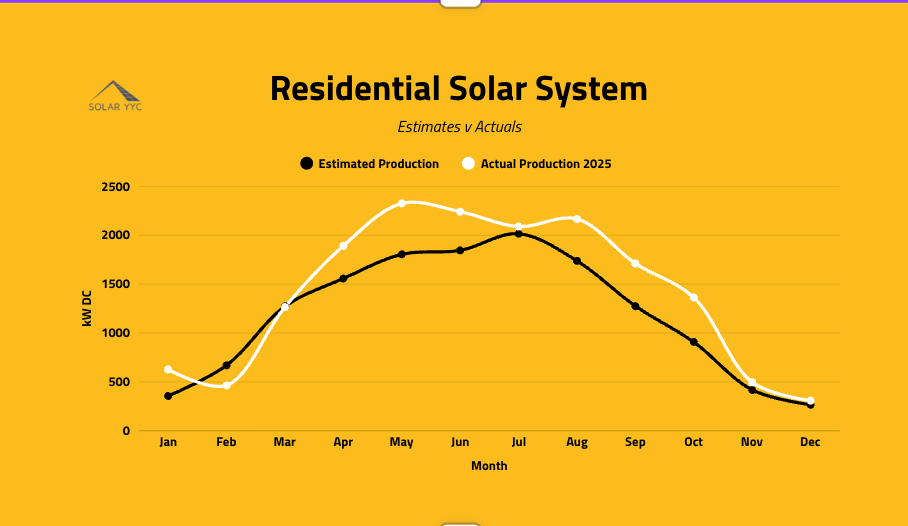
Yes. In this Solar YYC case study of two Calgary homes, both solar systems exceeded their estimated annual electricity production. System 1 generated 20% more energy than estimated, while System 2 produced 10% more. While monthly production fluctuates due to Alberta weather, annual solar yields are highly reliable. A solar proposal estimates how much energy a system will generate over a year, but real-world variables like snow, cloud cover, and seasonal shifts impact actual electricity output. To determine the accuracy of our models, we compared the original production estimates of two Solar YYC residential installations in Calgary against a full year of actual production data. The result: both systems produced more energy than originally projected. Case Study 1: 36-Panel System (20% Above Estimate) The first system was designed with 36 solar panels, an estimated 91% energy offset, and projected annual production of 14,125 kWh. That seasonal production was also important to the homeowner’s energy strategy. Higher summer production could be exported through a Solar Club, helping generate credits that could offset electricity costs during lower-production months. Designing Around the Home Before looking at the production numbers, it’s worth looking at how the system was designed. The thermal imagery helped our designers understand how sunlight moved across the property and identify the areas with the strongest solar potential. That information was then used to determine the optimal panel placement for the home. What Was Estimated vs. What Actually Happened? The monthly production follows the pattern you would expect from an Alberta solar system: generation builds through the spring, peaks during the brighter months, and then declines heading into winter. But when we compare the estimated production with the actual production, things get more interesting. The original estimate projected 14,125 kWh of production for the year. The system actually generated 16,951 kWh. That means it finished the year 2,826 kWh above the original estimate, approximately 20% more than projected. However, the system didn’t outperform the estimate evenly throughout the year. In January, for example, the system generated 627 kWh, compared with an estimated 356 kWh. That’s approximately 76% more than projected. February went the other way, with actual production coming in below the estimate. Then came October. The system was expected to produce 908 kWh, but actually generated 1,364 kWh — approximately 50% more than projected. September was also well above estimate, coming in 34% higher. This is where looking at the entire year becomes important. A month that produces less than expected doesn’t necessarily mean the system is under performing. Likewise, one unusually strong month doesn’t tell the whole story. Production can move around considerably from month to month, while the annual total can still end up well above the original projection. For this system, the stronger months more than made up for the weaker ones. By the end of the year, the difference was significant: 2,826 kWh more energy than originally estimated. Case Study 2: 27-Panel System on a Complex Roof (10% Above Estimate) This installation included 27 solar panels, with an estimated 92% energy offset and projected annual production of 9,653 kWh. This second home presented roof design challenges due to existing vents and a chimney. To maximize panel placement without going over the roof edges, Solar YYC completed a drone study to capture centimeter-level measurements. How Did the Second System Perform? Just like the first system, production varied throughout the year. Spring and summer brought the strongest generation, while production declined through the fall and winter. But once again, the monthly results didn’t always match the original projection. The system was estimated to produce 9,653 kWh over the year. It actually generated 10,630 kWh. That’s 977 kWh more than projected, approximately 10% above the original estimate. Just like the first system, there were some significant swings along the way. February was approximately 40% below estimate, producing 249 kWh compared with 413 kWh projected. December was also below projection, generating 160 kWh compared with an estimated 240 kWh. But then the stronger months started to add up. In May, the system produced 1,644 kWh, compared with 1,245 kWh estimated approximately 32% above projection. June finished 25% above estimate, while August came in 18% higher. By the end of the year, those higher-production months had more than offset the months that came in below projection, resulting in 977 additional kWh of solar energy that wasn’t included in the original annual estimate. What Can We Actually Learn From a Year of Solar Data? Looking at these two systems side by side reveals something that a single production estimate can’t: solar performance isn’t perfectly predictable month to month, but the annual picture can still be remarkably strong. Both systems had months where production fell below the original projection. Both also had months where they significantly outperformed it. What mattered was how those differences added up over the full year. The first system was projected to produce 14,125 kWh but generated 16,951 kWh — 2,826 kWh more than estimated, or 20% above projection. The second system was projected to produce 9,653 kWh but generated 10,630 kWh — 977 kWh more than estimated, or 10% above projection. That doesn’t mean every solar system will outperform its estimate by 10% or 20%. Production will always depend on the specific property, system design, weather and other real-world conditions. What these examples do show is why it’s important to look at solar production over the course of a full year rather than judging performance by any single month. A month that falls short of its estimate doesn’t necessarily mean a system is under performing. And a particularly strong month doesn’t necessarily mean the system will continue at that level. For these two homes, that story was simple: both systems not only met their original production estimates, they exceeded them. Learn more about Residential Solar Hear about our customers experience going solar in Calgary

Everything you need to know about Solar Batteries in Alberta: How it works, Costs, & Setup

Battery storage allows homeowners to store their own clean energy, reduce their reliance on the grid, gain more control over how and when they use their electricity, and stay powered during outages. If you’re considering solar or already have a system, you’ve likely heard of “energy independence.” While batteries play a key role in making this possible, a successful system starts with understanding how energy storage works and whether it’s the right solution for your home. In this blog, we will break down solar battery storage in simple terms and explain how it operates alongside your solar panels. We’ll also explore how it offers your home greater flexibility and control over energy use while addressing the most frequently asked questions about solar batteries. How Does Solar Work Without a Battery? During the day, your solar panels convert sunlight into electricity, and your home uses that energy first before drawing any additional power from the grid. If your system produces more electricity than your home is using, the excess energy is sent back to the grid, where you earn credits through your electricity retailer. At night or during low-production periods, your home will draw power from the grid as usual. Your earned credits help offset the cost of this electricity, though you still pay regulated delivery and distribution charges. A common misconception is that solar panels provide power during a blackout. However, most systems automatically shut down when the grid goes offline to protect utility workers. This is where battery storage changes the game. With Alberta’s incredible solar potential and long summer days, your panels can often produce more energy than your home uses during peak sunlight hours. A battery allows you to store that excess energy and keep it available for when the sun isn’t shining or when the grid goes down. How does Solar Works With a Battery? Instead of sending all of your excess solar energy back to the grid, a battery can store that electricity so it can be used later when your panels aren’t producing enough power or provide backup power during an outage. How that stored energy is used depends on your battery settings, which can be adjusted through the batteries app. Some homeowners choose to keep their battery capacity reserved primarily for emergency backup power. In this setup, the solar system continues operating like a standard grid-tied system, sending excess energy back to the grid while the battery stays charged and available for an outage. Other homeowners choose to use their battery daily, allowing stored energy to power their home during the evening or periods of lower solar production while keeping a reserve available for emergencies. A battery simply adds a storage option for the excess energy your solar panels generate. How that stored energy is used depends on the homeowner’s energy goals and preferences. Different Battery Options for Different Energy Needs Battery systems are highly customizable, allowing you to tailor your storage capacity to your home’s energy needs, budget, and backup goals. Unlike solar panels, where pricing scales with the size of the installation, battery costs are typically fixed per unit. Your total investment depends on the specific technology you choose and the number of units required to meet your goals. Now let’s talk about different batteries for different levels of backup. Partial Home Backup A partial home backup is a more budget-friendly choice for homeowners who want to prioritize essential circuits during a power outage. This setup ensures that critical items such as your refrigerator, furnace, Wi-Fi, and select lights remain operational when the grid goes down. By focusing on these key outputs rather than the entire house, you can maintain comfort and safety without the higher cost of a larger storage system. For example, a single Soluna battery for a partial backup typically starts around $15,000, while a two-particle home battery  may range up to $19,000, fully installed. Whole Home Backup For homeowners seeking total energy independence and peace of mind, a whole-home backup system ensures every outlet and appliance remains live. Batteries like the Tesla Powerwall are designed to handle heavier household loads, including air conditioners and electric dryers. Because of the increased capacity and specialized integration required, these systems generally cost between $20,000 and $25,000 per battery.  No matter which battery you go with, they usually end up in the same spot. Most of the time, that’s your garage on a fire-rated wall with a self-closing door to meet local safety rules.  Lifespan & Warranty of Battery Storage Like a smartphone, a solar battery’s lifespan is influenced by its charging cycles. Over time, repeated charging and discharging can lead to gradual degradation, though modern solar batteries are designed to operate efficiently for well over a decade. To protect this investment, manufacturers provide warranties. For example, a Soluna battery includes a 10-year warranty or a limit of 8,000 cycles (where one cycle represents a full charge and discharge of a battery). At a rate of one cycle per day, 8,000 cycles could theoretically provide over 20 years of covered performance. Batteries are built to last, and everyday usage typically has only a small impact on their overall lifespan. However, how frequently and deeply a battery is discharged can affect long-term performance. Battery preservation settings help reduce stress on the system by limiting how high the battery charges and how low it discharges during normal use. For example, some settings may keep the battery around 80% capacity and prevent it from dropping to 0% unless backup power is needed during an emergency.  How to Customize Your Battery Settings One of the benefits of battery storage is that it can be customized around your household’s energy needs with ease.  Many battery systems allow homeowners to choose how their stored energy is used. Some homeowners may prioritize keeping more energy available for emergency backup, while others may choose to use more stored energy daily to reduce their reliance on the grid. For example, a homeowner could reserve 100% of their battery capacity

The Truth About 0% Solar Financing: Fees, Rates & Real Costs

For many homeowners, “0% financing” immediately shifts the conversation away from critical long-term factors (total project cost, engineering quality, contractor stability, and lifecycle value) and instead focuses entirely on the lowest monthly payment. While financing makes renewable energy accessible without the upfront cost, it is critical to understand how these promotional structures actually operate in the market. After the federal Greener Homes Loan program ended in October 2025, many solar providers began marketing new “0% financing” alternatives.  However, these private structures are fundamentally different from former government programs, and “0% financing” rarely equates to free financing. The Role of Hidden Dealer Fees In many cases, third-party financing providers charge solar contractors significant upfront fees in exchange for offering promotional terms, extended amortizations, or low monthly payments. Commonly referred to as dealer fees, financing buy-downs, or merchant fees, these costs are typically recovered by embedding them directly into the upfront contract price. The actual dealer fee associated with many of these new 0% loan products is approximately 29.99% added to the cash price of the solar system. This means the homeowner finances the high cost of the borrowing itself from day one. Because these fees are wrapped directly into the principal, consumers are often presented with a final financed price without realizing that nearly one-third has been added to the original cost of the infrastructure just to access the “0%” headline rate. Consequently, a crucial step for any homeowner evaluating a solar proposal is to explicitly ask the contractor for two separate figures: Transparent contractors should disclose whether dealer fees exist, how financing impacts the baseline pricing, and what the total cumulative repayment looks like over the life of the agreement. If a company is unwilling or unable to clarify the difference between the cash and financed price, customers should be cautious before proceeding. Analyzing the Fine Print and Amortization Risks Promotional financing models are rarely as straightforward as their marketing headlines suggest. A common structure utilized in the current market involves a 5-year 0% promotional term amortized over a 20-year period. At the end of that initial 5-year window, any remaining principal balance automatically converts to a standard interest-bearing loan (often carrying high interest rates around 12.99%) for the remaining 15-year amortization. To minimize consumer concern, sales representatives frequently advise clients to “simply roll the remaining balance into their mortgage at renewal”. However, this presents a significant financial risk: Furthermore, some financing models assume that homeowners will receive independent grants or rebates and apply those lump-sum proceeds directly against the loan balance within the first few years. If those external funds are not applied, the monthly payments or overall amortization structures can change drastically. Impact on Principal Repayment and Flexibility In a conventional fixed-term interest loan, interest accrues transparently over time rather than being locked into the principal upfront. This structure grants the homeowner flexibility, as any additional or early payments directly reduce the remaining principal balance and lower future interest costs. Conversely, with many dealer-fee-based 0% loans, there is virtually no financial benefit to paying the loan off early. Because the 29.99% financing fee was already permanently baked into the principal on day one, the remaining principal balance after five years of consistent payments can still easily exceed the original cash price of the solar installation itself. Conclusion: Evaluating Solar as Long-Term Infrastructure A solar array is not a temporary or purely transactional consumer purchase; it is a decades-long investment attached to a primary financial asset. Every project requires site engineering, electrical infrastructure constraints, utility interconnection approvals, and multi-decade production modeling. The danger arises when financing becomes the primary product being sold, and the solar system itself becomes secondary. This shift prioritizes speed and transactional urgency over consumer education and long-term asset performance. This information is not compiled to discourage consumers from financing their transition to renewable energy. Rather, it is designed to provide the clarity and transparency required to make an informed economic choice. In many cases, utilizing a conventional fixed-term bank loan, a home equity line of credit (HELOC), or another transparent lending product will provide significantly greater flexibility and lower long-term cumulative costs than a dealer-fee-based 0% financing program. Homeowners must carefully scrutinize total repayment costs, future remaining balances, and underlying refinancing assumptions before signing an agreement. Want a transparent second opinion on your solar numbers? Financing shouldn’t be a black box. If you’ve been offered a 0% deal and want to make sure there aren’t hidden fees baked into your contract principal, our Calgary team is here to help. Visit our Home Page

Is Solar Worth it In Alberta? The truth about ROI and Ethical Sales

The Alberta solar market is growing fast, but with that growth comes a responsibility to ensure homeowners are getting the full, honest truth about their investment. We recently had the honor of presenting at a Solar Alberta webinar to discuss a topic close to our hearts: Ethical Sales.Our President at Solar YYC, Brett Bauman, led a deep dive into why “sunshine math” and inflated promises are damaging industry trust. We believe that a solar array isn’t just a 25-year piece of hardware; it’s a 25-year relationship based on transparency. The Danger of the “Optimistic” Proposal It is tempting for sales teams to present the best-case scenario to close a deal. However, overstating Return on Investment (ROI) or using inflated electricity escalation rates can lead to a “6-year payback” promise on what is actually a “12-year investment”. When the system fails to meet these exaggerated expectations, it doesn’t just hurt one company; it damages the reputation of the entire industry. The Three Pillars of Ethical Modeling To do right by the customer, installers must be transparent about three critical variables: 3. Conservative Production Estimates: Under-promising on how much energy a system will produce leads to happy customers who become lifelong advocates when their system over-delivers. Conclusion As we discussed in our recent session with Solar Alberta, the rapid growth of solar in our province is exciting, but it must be matched by a commitment to consumer protection. At Solar YYC, we believe that transparency regarding electricity escalation, financing costs, and realistic production is the only way to move the industry forward. A solar array is a major financial milestone. You deserve a partner who respects your time, values your trust, and provides the “worst-case” and “best-case” scenarios so you can plan for the future with clarity. Are you ready to see what the numbers actually look like for your roof? Don’t settle for a “best-case” pitch. Get a comprehensive, ethical proposal from Solar YYC that includes the full financial picture Click Here to Book Your Transparent Consultation Watch the full webinar HERE

How to Avoid Rising Energy Admin Fees in Alberta

Alberta, we hear you. With administrative fees creeping up, energy bills are feeling heavier than ever, especially in today’s affordability crunch. The good news? While your bill might look complicated, choosing a better retailer doesn’t have to be. Starting March 1st, one of the Big Three is increasing its administrative fees for electricity and natural gas from $0.33 per day to $0.36 per day. At first, a three-cent daily increase might not seem like much. But over time, these small daily charges add up—almost $400 in administrative fees alone over a typical three-year contract! And that’s before you even pay for electricity or natural gas. At Blue Ring Utilities, we do things differently. Instead of charging a daily administrative fee, we offer a simple flat rate of $8.85 per month. Compared to a $0.36/day fee, that’s roughly $75 in savings over three years per commodity. Let’s break it down: If you’re looking to reduce unnecessary fees and keep more of your hard-earned money, now’s the perfect time to explore your options. Sign up today and lock in our promotional rate of 8.27¢/kWh (that’s just $62.03 for electricity on an average 750 kWh/month*). No Surprise Riders Some providers automatically default customers to the Rate of Last Resort (ROLR) and charge additional riders—cost recovery tools that appear as extra daily fees on your bill. BRU doesn’t do this. With us, you get a clear, predictable bill—no surprises. Powering Communities, Not Just Homes When you choose Blue Ring Utilities for electricity, natural gas, or internet, you’re doing more than lowering your bill—you’re supporting local communities. As a locally owned and operated Alberta business, we donate 10% of profits from your bills to help fight food insecurity in Calgary with iCan for Kids.  *The BRU’s Promotional Discount Rate of  8.27 cents/kWh is guaranteed until September 30, 2026, followed by 8.60 cents/kWh is guaranteed until August 2028. Promo rate requires a one-time prudential payment. See website for details.

Call 587 296 7375