Solar

home solar system maintenance

The Ultimate Home Solar System Maintenance Guide

Many people ask us about home solar system maintenance, and we’re always pleased to tell our clients that we look after that for them. However, if you have solar panels from another installer and they do not offer care and maintenance, or you did the installation on your own, here is what you need to know. Do Home Solar Systems Need Extensive Maintenance? Before we start with the actual maintenance guide, we need to clarify that solar panels generally don’t need much maintenance. However, homeowners must know what signs they must be aware of and how to perform maintenance work if needed. Home Solar System Maintenance Guide: 7 Steps to Keep Your Panels Up and Running 1 – Cleaning Most of the time, rain will take care of cleaning your panels, but it’s a good idea to do a deep cleaning at least twice a year to remove dust or debris accumulation, especially when it isn’t raining much. If you see an energy production drop, cleaning your panels will likely solve the problem.  Use this method to clean the panels: If your panels are on the roof and you don’t like the idea of going up there, consider hiring a professional cleaning company. 2 – Monitor Energy Production Look at the energy production of your solar panels regularly. If you notice a significant drop in power output, it could indicate a problem that needs attention. If your solar panel system has monitoring software, use it to track performance and identify any issues. 3 – Shade Management Trim or prune trees and vegetation that may cast shadows on your solar panels, as shading can significantly reduce energy production.  4 – Check Inverter Performance The inverter turns the direct current (DC) produced by the solar panels into the Alternate Current (AC) power you use in your home. Regularly check the inverter’s readings and make sure it is functioning properly. If the inverter displays error messages, consult the user manual, contact the manufacturer if you did the installation, or reach out to your installer company for guidance. 5 – Record Tracking Record your maintenance activities, including cleaning dates, any issues observed, and repairs made. This log can be useful for future reference and warranty claims.  6 – Warranty Review Familiarize yourself with the warranty terms of your solar panels. Some warranties may require specific maintenance practices to remain valid. 7 – Other Considerations Owning Solar Panels Is Easy Solar panels are a low-maintenance investment that has many benefits. Although they won’t require much effort to keep them in good condition, you must know how to troubleshoot if needed. If you need further assistance, don’t hesitate to get in touch with us.
Half-cut vs full solar panel cells

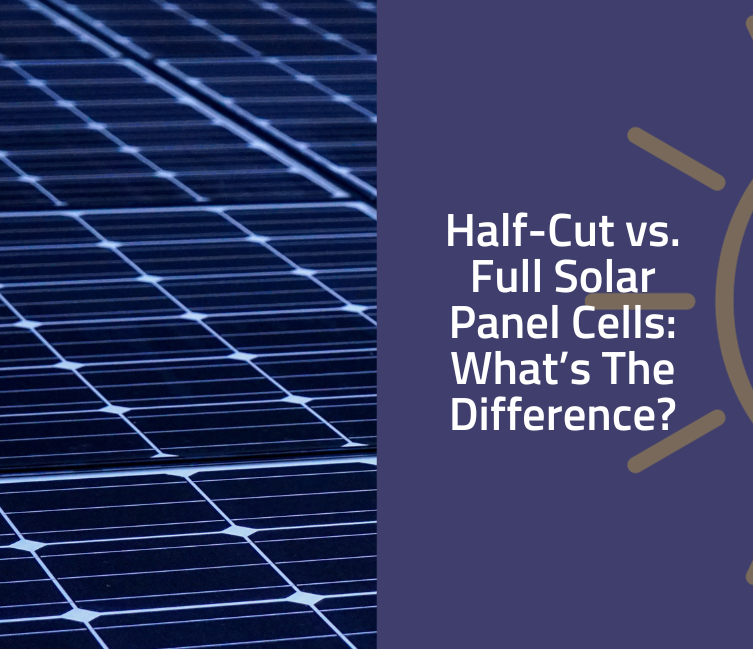
Half-Cut vs. Full Solar Panel Cells: What’s The Difference?

Photovoltaic (PV) cells are a fundamental piece of how solar panels produce energy as they’re in charge of absorbing the sunlight that will turn into electricity. And the constant technological advancements looking for ways to make PV cells more efficient while keeping the costs in check has led to the development of different types of solar cells.  This time, we’re going to focus on half-cut and full solar panel cells, how they work, and making a comprehensive comparison so you can know how to choose which one will be the most suitable for your needs.  First, What’s a Solar Cell? A solar cell is a device made of a semiconductor material (typically silicone) that turns sunlight into electrical current through a physical process called the photovoltaic effect. Solar cells are the primary building blocks of solar panels, but a single one can’t produce enough energy, so panels are made with several cells arranged together.  The number of cells in a solar panel typically ranges from 36 to 144 cells or more, and this amount varies for several reasons, including design considerations, desired voltage and current output, efficiency goals, and the specific requirements of the installation. For residential installations, 60-cell panels are the most common, while businesses and bigger projects use panels with 72 cells or more. What Are Full Solar Panel Cells? Full-cell panels use standard-sized solar cells without cutting them. They typically have fewer cells than half-cut cell panels, as the most common full-cell panels on the market tend to have between 60 and 72 cells. What Are Half-Cut Solar Panel Cells? Half-cut solar cells, as the name suggests, are solar cells that have been physically cut in half. This process is done by dividing a standard-sized solar cell into two equal parts. Half-cut solar cells are a technology innovation developed by REC Solar back in 2014 as a way to increase energy production performance.  Cutting the cells in half results in twice as many cells in a panel compared to full-cell panels. For example, a standard panel might have 60 cells, while a half-cut cell panel could have 120 half-cells. Half-Cut vs Full Solar Panel Cells Differences Now that we have covered PV cells’ functionality and the definition of full and half-cut cells let’s dive into the main differences between them: 1 – Electrical Resistance Electrical resistance refers to the opposition to the flow of electric current through the material or components of the cell. In solar cells, electrical resistance can translate into energy loss and reduced efficiency. Half-cut cells have lower electrical resistance than standard cells, which can reduce power loss due to resistance in the panel’s internal wiring and connections. 2 – Shading Tolerance Shading is a critical variant that can significantly impact the energy output of solar panels, as even a slight shadow can compromise the overall efficiency of the solar system.  Conventional PV cells are more sensitive to shading. Even if a portion of a cell is shaded, it can significantly reduce the panel’s power output because the entire cell is affected. In opposition, half-cut cells tend to tolerate better shading conditions. If one part of a half-cut cell is shaded, it has a smaller impact on the overall panel’s performance because the cells are divided into smaller sections. 3 – Heat Generation While heat generation is a normal aspect of their operation, solar panels that operate at lower temperatures tend to have improved efficiency, reliability, and longevity while minimizing the risk of hotspots that can potentially damage the solar cells or cause complete failure.  Traditional cells often generate more heat than their half-cut counterparts for several reasons, including higher resistance, size, and higher current levels. Half-cut cells generate less heat because they have lower resistance and less material to heat up, thus absorbing less energy and retaining less heat. 4 – Reliability Due to their lower operating temperatures and reduced electrical resistance, half-cut cell panels may have a longer lifespan and higher reliability than full-cell panels. While full-cell panels are still reliable, they may not have the same longevity as the half-cut cell ones. 5 – Cost Half-cut cell panels are generally more expensive due to the additional processing required to cut the cells in half. However, their improved efficiency and longevity can make them cost-effective in the long run compared to the initial cost savings full cells may offer.  The Final Take While both types of solar cells have their uses and advantages depending on the specific installation requirements and the project’s goal, you’ll make the best of your investment by investing in half-cut solar panel cells.  We at Solar YYC use panels with half-cut cell technology in our installations because they offer a high-level performance and long-term reliability that standard cells can’t match. If you want to know more about solar panel technology and how much energy a solar system adapted to your needs can produce, reach out and book a free consultation.